By Brooke M. Vena, Intern
Here at the Litchfield Historical Society, we have had the privilege of receiving a recent donation of artwork and objects collected and created by Litchfield resident Austin M. Purves Jr. These materials represent his life, and can tell us a lot about who he was as a person as well as an artist. After processing these materials, we are now able to understand Purves, his life, and his relationship with religion on a much deeper level through examining the way he presents it in his art. By exploring this, we can almost begin to see the world through Austin Purves’ eyes.
At least two things in this world have proven to be inherently human and present in virtually every civilization in history: religion and art. For as long as humans have been around, we have always created art and had some sort of religious or spiritual culture because we have an innate desire for meaning; both to understand and portray it. Austin Purves is no exception.
An example that encapsulates and immortalizes both of these pieces of humanity are places of worship. Cathedrals, chapels, and churches have been intricately and intentionally designed and decorated for as long as they have been around, and have naturally become a subject of interest and study for both the artistic and the religious. Austin Purves spent his life as both a devoted Christian and lifelong artist– the depth of which becomes clear in his paintings, sketchbooks, and journals. These places, which combine perhaps his two biggest passions, continue to reappear throughout his life and work.
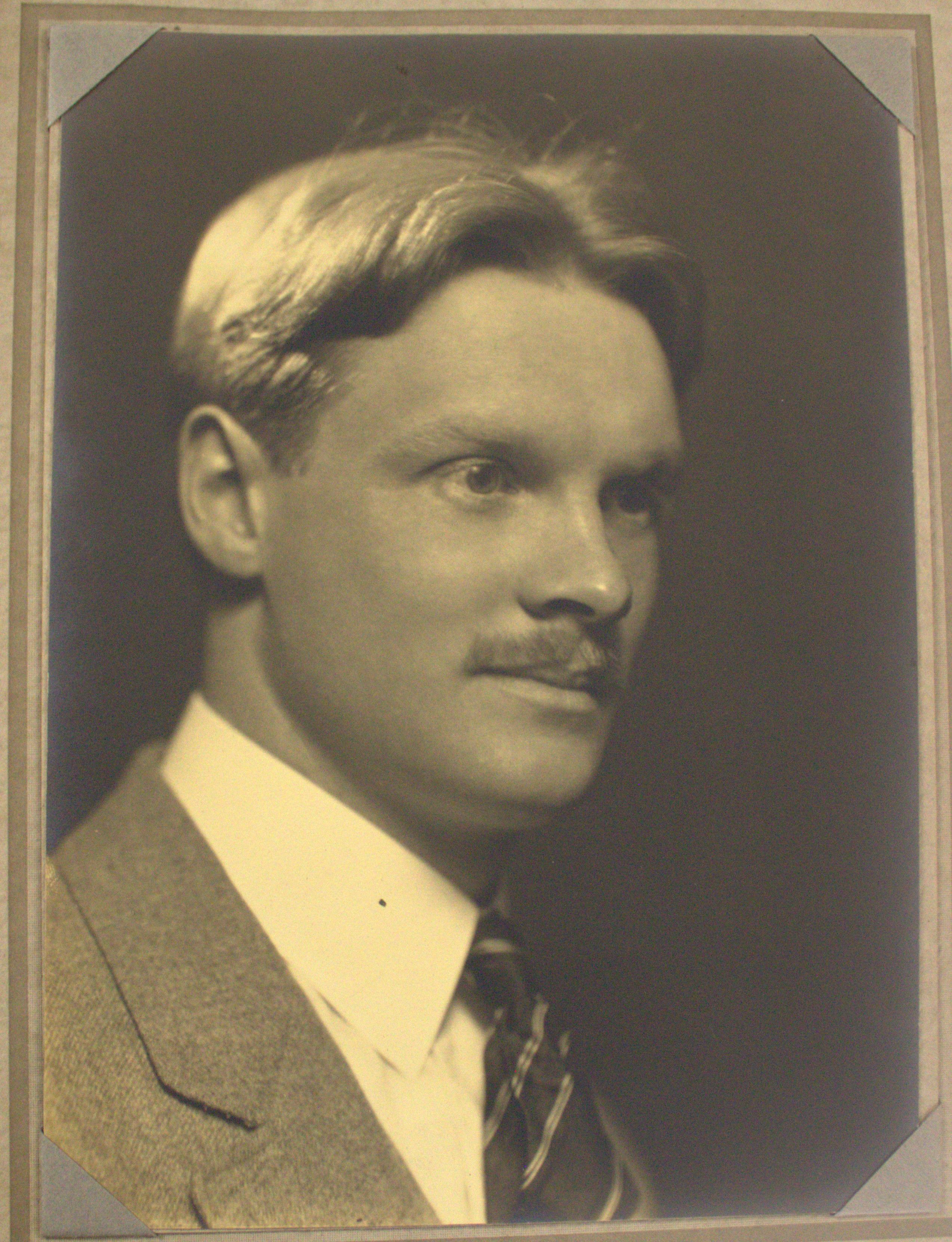
The Artist’s Spirit of Austin Purves
Austin M. Purves, born in 1900 in Philadelphia, PA, had a lifelong artistic journey tied to his education and faith. He studied at the Philadelphia Institute of Fine Arts and the Julien Academy in Paris, France, and traveled across Europe studying frescos in churches and municipal buildings– eventually earning an award from the Department of Beaux Arts of France for a fresco he painted in a 13th century church in Montarlot, France.
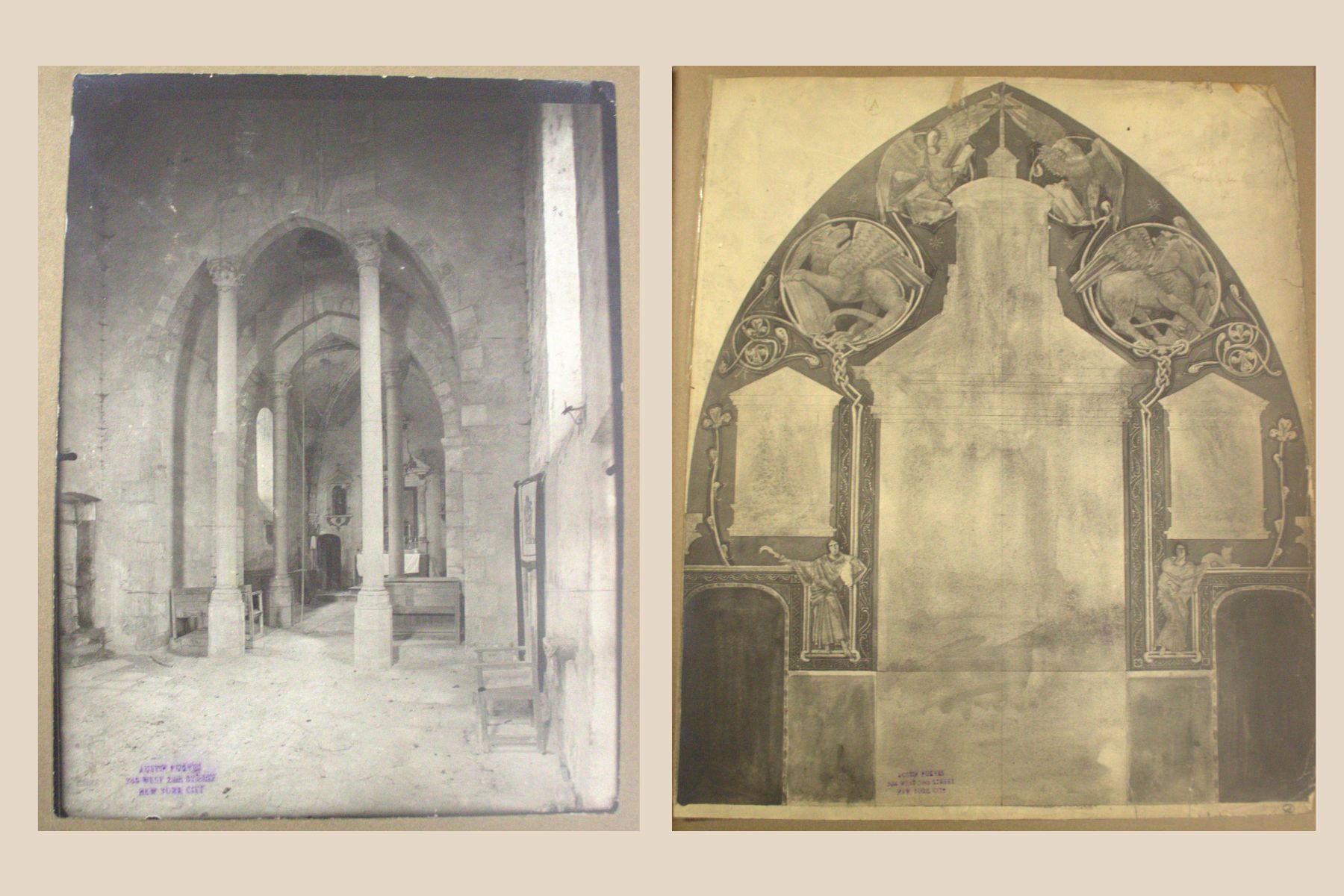
(R) Design for award-winning fresco at St Mammes-Montarlot Church
After his return to the United States, he acquired a studio on the Lower East Side of New York City and continued his professional career doing a great deal of work for private customers. He painted an Alms Box for St. Paul’s Church in Philadelphia, always allowing himself to return to his roots in religious art.
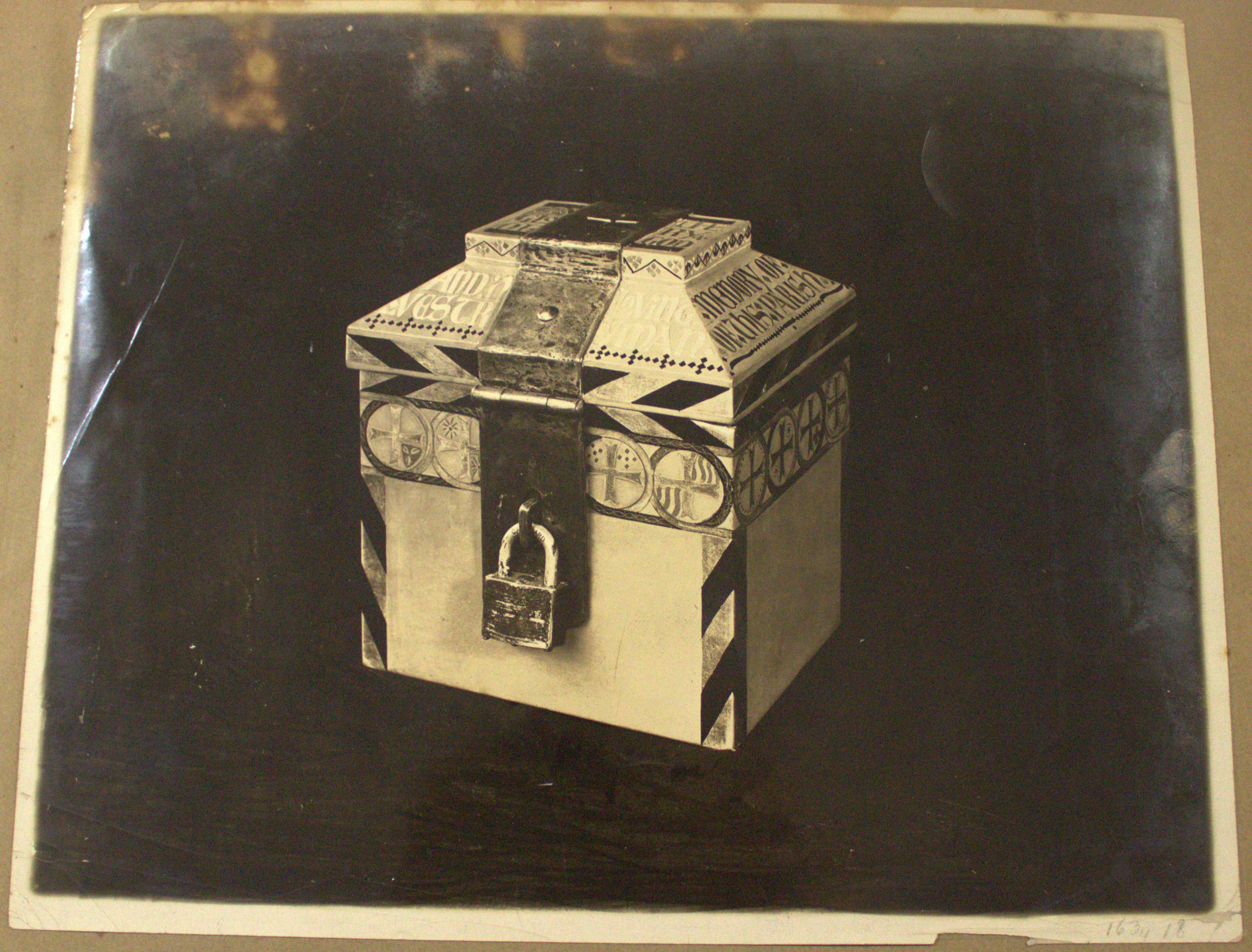
He was well known as a deeply religious man, and this is clearly evident in his art and writings’ focus on religious themes. In fact, after Purves’ passing in 1977, one of his fellow members of the Century Club Association of New York referred to him as a true ‘scholar in the field of religious art’, calling much of his work ‘religious in nature’.
The last four decades of Purves’ life were spent in Litchfield, Connecticut, and the town became an integral part of his life and work. He made his home in East Litchfield with his wife and children, and built an art studio on the property in a converted barn. During his time in Litchfield, Purves was deeply involved with St. Michael’s Church, teaching Sunday school, singing in the choir, and serving as a vestryman and warden. His religious devotion seeped into every aspect of his life, though his art is perhaps the clearest demonstration of it.
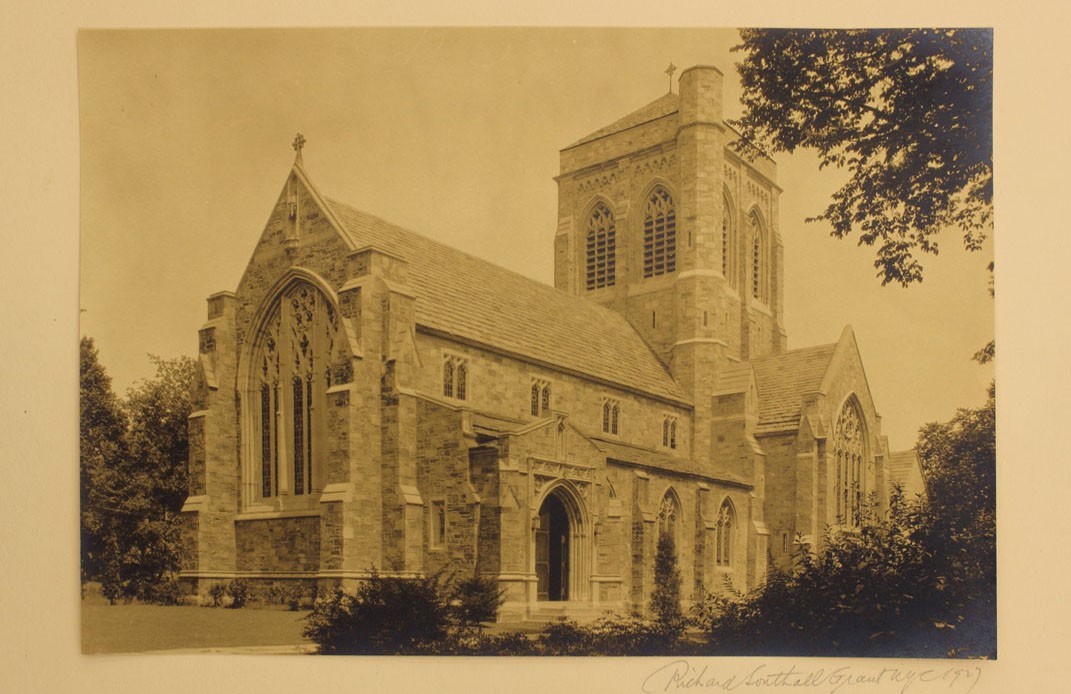
St. Joseph, Defender of the Church and Patron of Workers Mosaic
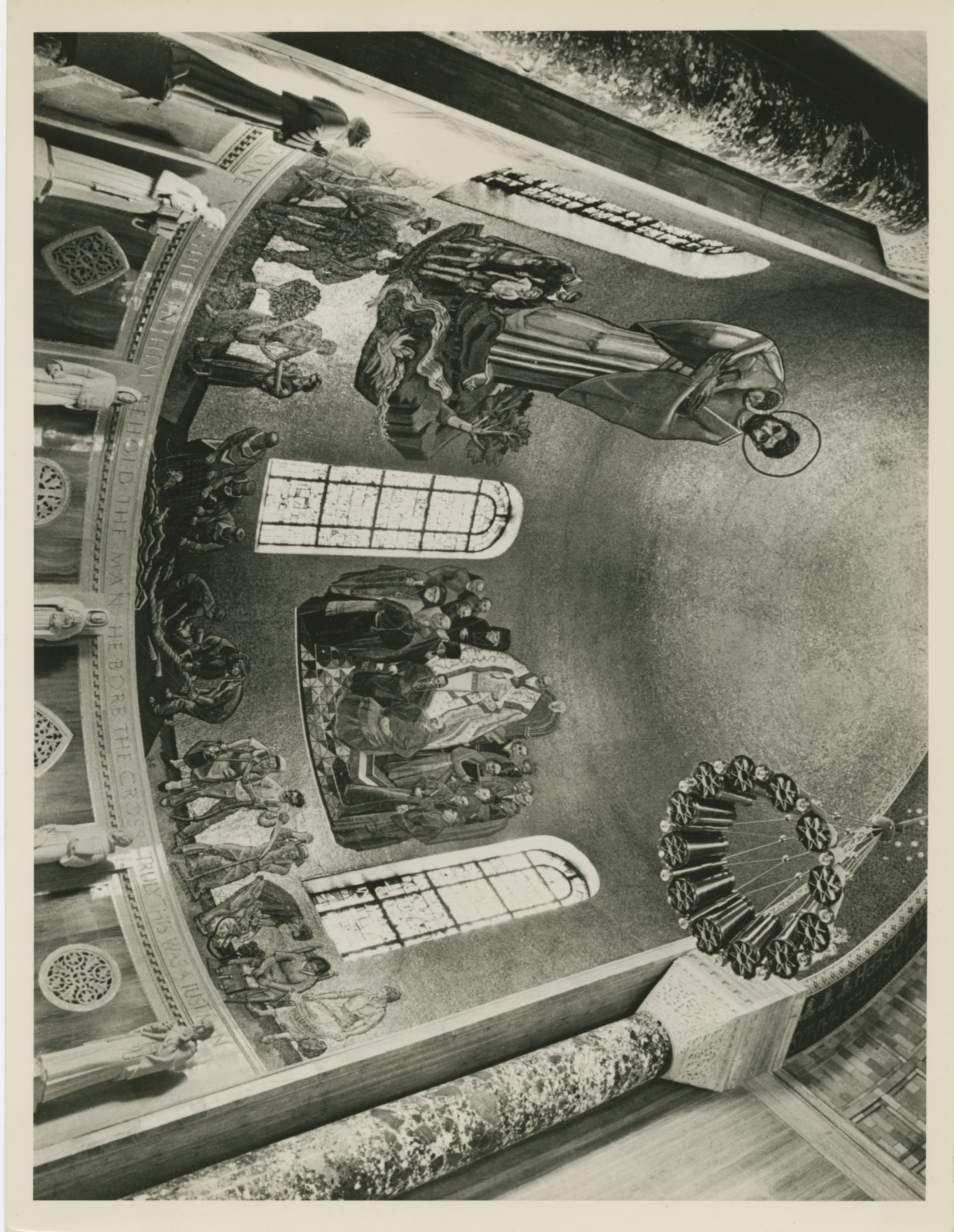
One of Austin Purves’ greatest and most famous pieces is the 3,500 sq. ft. “St. Joseph, Defender of the Church and Patron of Workers” mosaic in the East Apse of the Basilica of the National Shrine of the Immaculate Conception in Washington D.C. The mosaic was designed and completed by Purves in 1964 in a Neo-Byzantine art style, to match the building’s architecture, and was manufactured by the Venetian Art Studios of NY. Some of the Historical Society’s newer acquisitions demonstrate Purves’ preparation and practice for this feat, as he was living and working in East Litchfield at the time.
St. Joseph, appearing on the left (north) holds in his arms the Christ Child and stands grandly above his family. St. Joseph here is a symbol of the Holy Family, and reinforces ideas of traditional patriarchal family life. At his feet is an array of workingmen, symbolizing his role as a model and patron of workers. St. Joseph’s grandness, with his head and halo at the ceiling, imposes a sense of authority over families and workingmen.
The main pieces from the LHS’s collection that are connected to this mosaic are sketches of the Pope – who is a main focal point in the finished mosaic – as well as preliminary patterns for the archway above it.
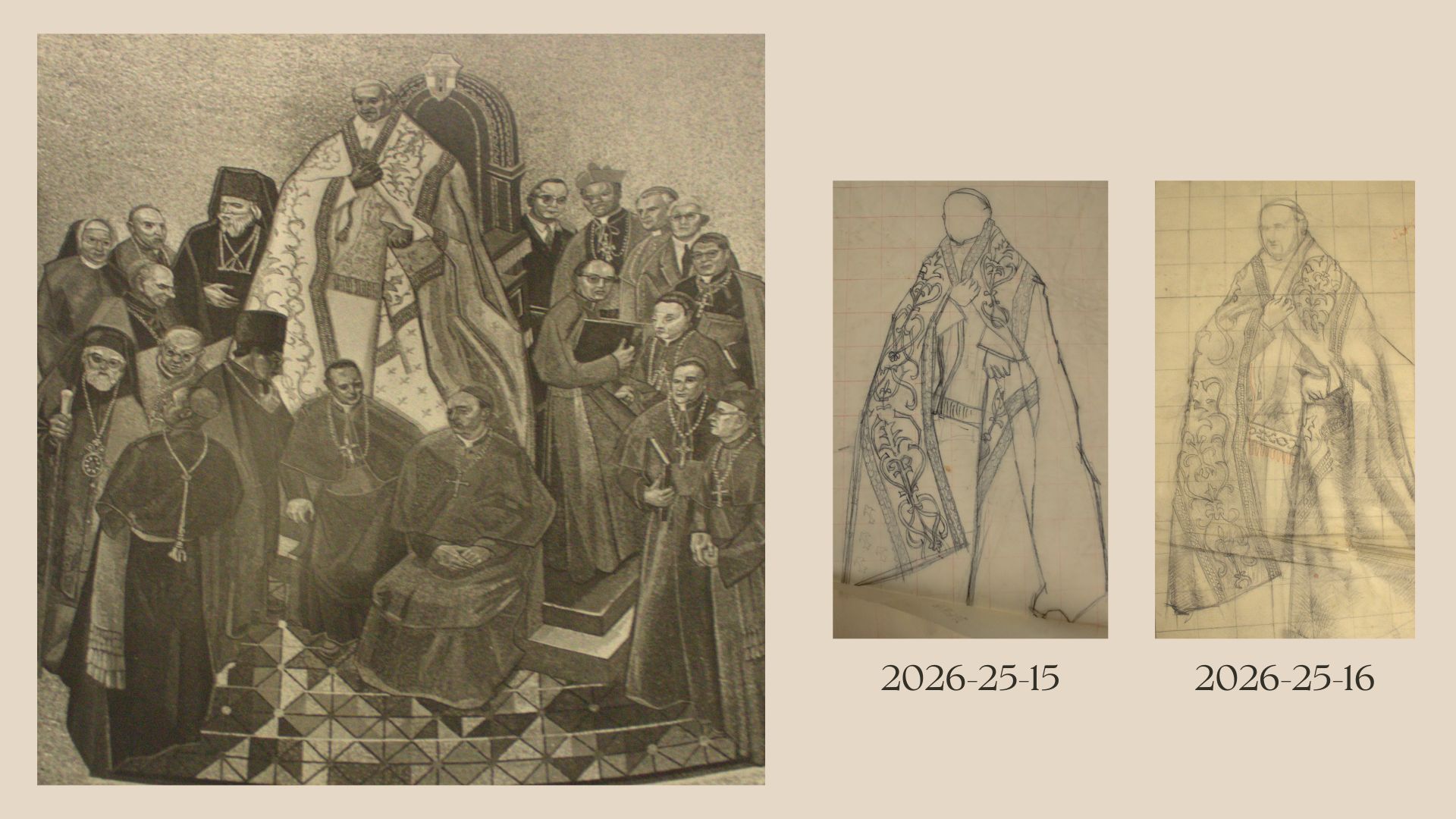
These sketches date to 1962, confirming at least two years of preparation. They depict Pope John XXIII, who was head of the Catholic Church from 1958-1963, and appears in the mosaic surrounded by the Ecumenical Group (a group of Council Fathers and observers who participated in Vatican Council II). From the drafts to the final image, we can see the development of how Purves wanted to portray the Pope’s clothing and drapes– the white of his robe contrasting the dark clothing of the Ecumenical Group, and the detailed pattern over his shoulder.
Another mosaic preliminary design we’ve recently accessioned is the pattern visible in the upper archway of the East Apse’s ceiling. Purves had multiple pattern sketches to border the edges of this archway, and the patterns reflect from their original sketches to the final mosaic. Here, we can compare the detail of the ceiling arch to the pattern drafts from our collection and see the direct resemblance between them. He eventually ended up leaning more towards the pattern with the thicker white lines (2026-25-29), as we can see below, giving us a glimpse into Purves’ artistic process.
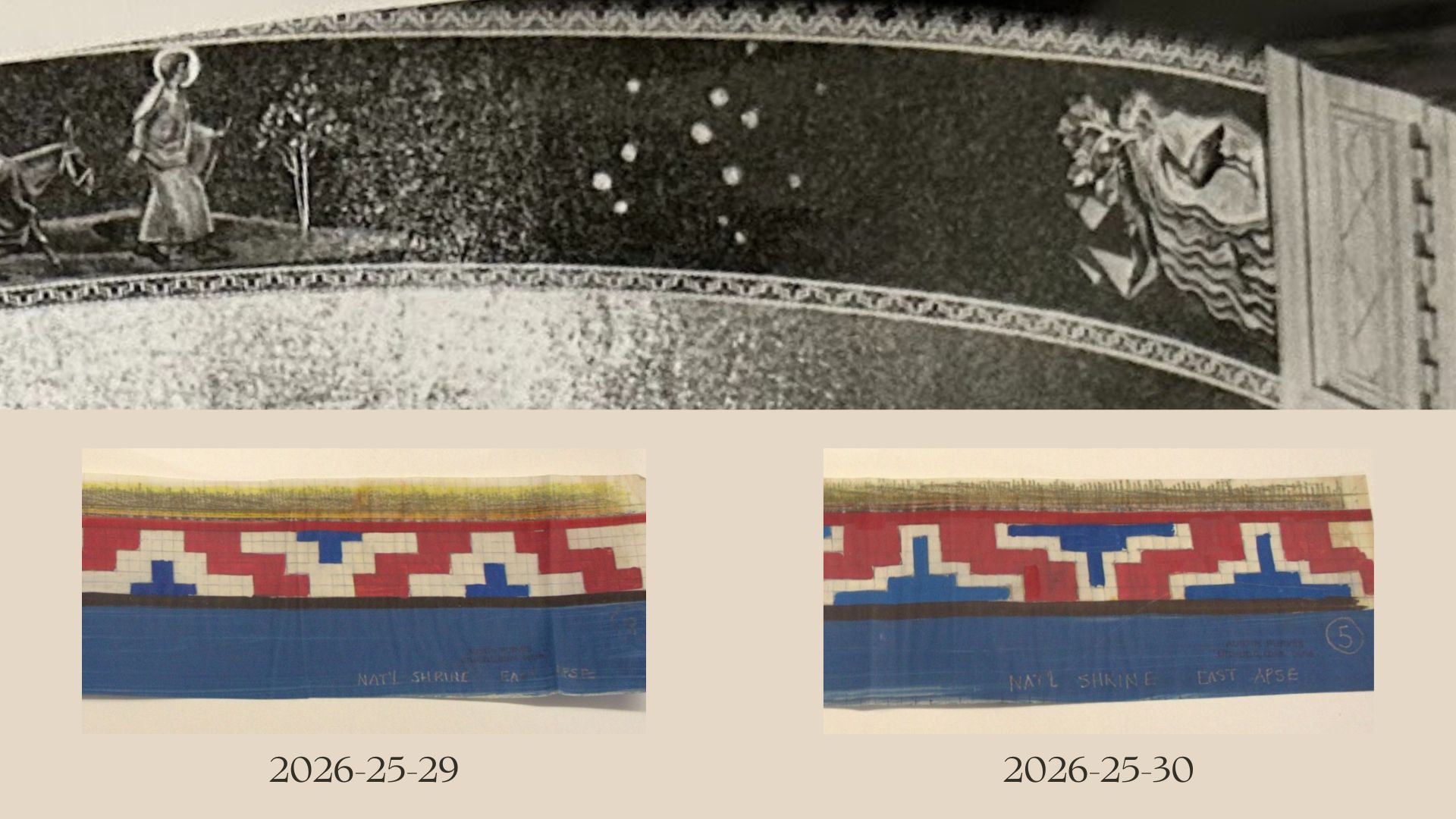
These patterns are reminiscent of classic Neo-Byzantine mosaic styles. The Byzantine Revival movement began in the mid-late 19th century, and as a whole aimed to symbolize the imperial grandeur and evoke the cultural heritage of the Byzantine Empire, and included iconic features like domed roofs, detailed mosaics, and apses. All of these architectural features are visible in the National Shrine, as one of the best examples of Byzantine Revival architecture in the West. Though this mosaic was completed while Purves was living in Connecticut, the many photos and studies from the National Shrine show that he visited Washington D.C. many times for research and preparation. It is clear that the building’s existing architectural style was deeply important to the style of work he was creating for it.
St. Alban’s Abbey Ceiling Panel Plans
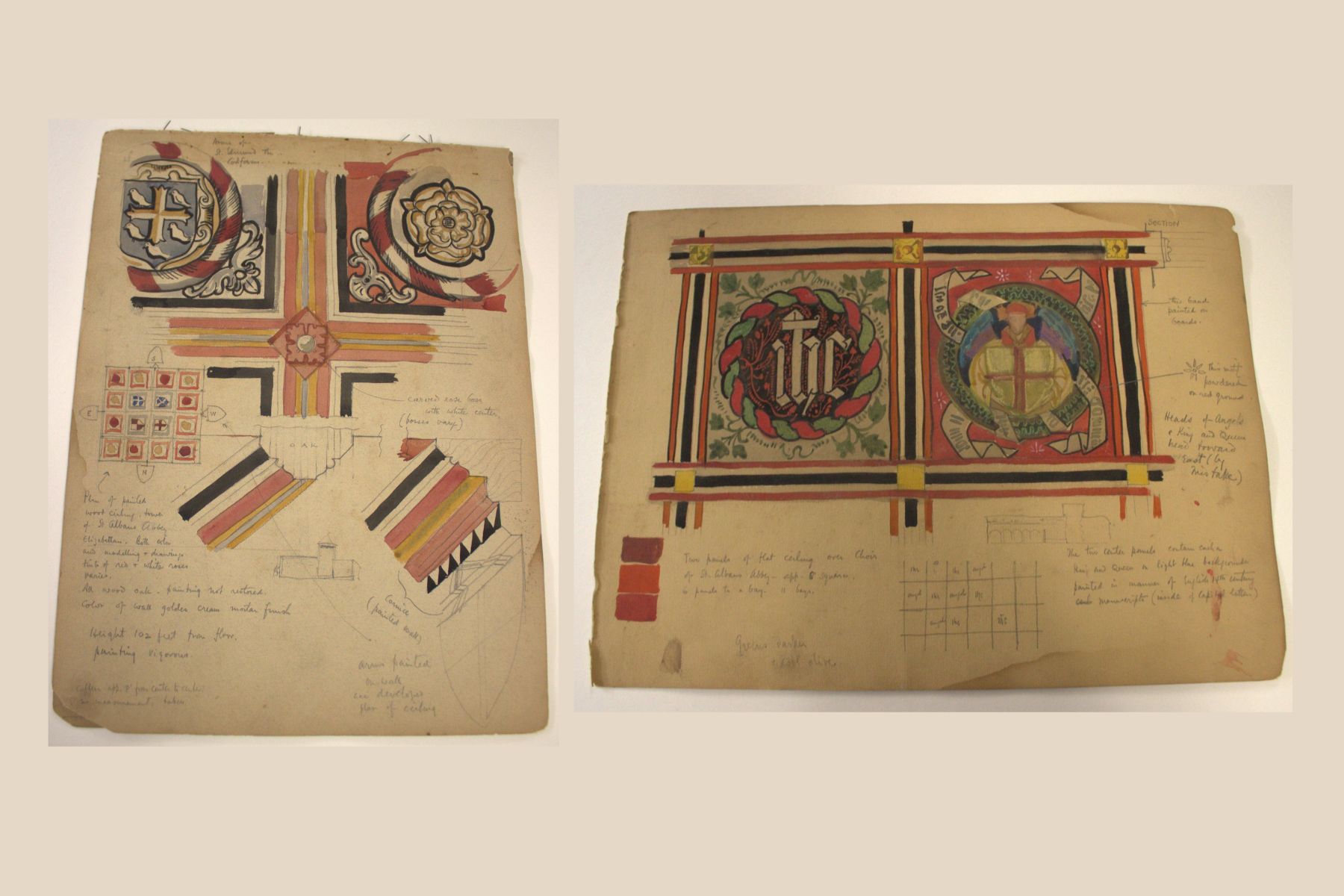
More items from our recent accessions are plans for ceiling panels of the tower of St. Alban’s Abbey in St. Albans, England. In the 1950s, the Abbey’s original medieval ceiling panels needed refurbishment during the building’s restoration following the second World War. In fact, there have been at least six repaintings of these panels throughout the life of the Abbey. After consulting the Abbey’s archivist, it appears that Purves himself did not do any official work on the actual tower ceiling, instead Janet Lenton is credited for the 1950s repainting. Perhaps Purves simply was using this as an example for studies– likely while living in Litchfield.
(R) Full plan 2 for St. Alban’s Abbey ceiling (2026-25-28)
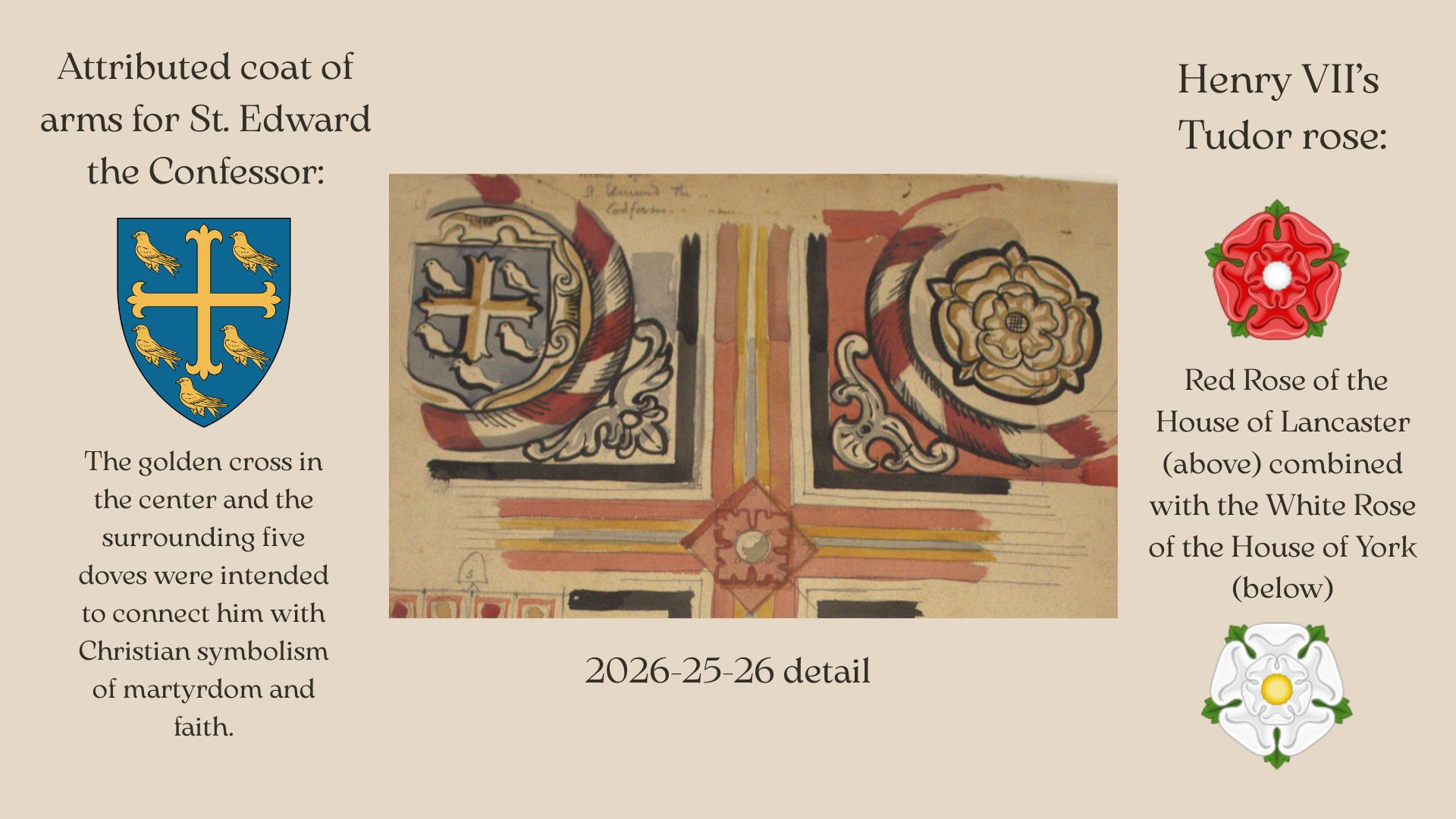
The top left design of 2026-25-26 features the attributed coat of arms of St. Edward the Confessor. He was king of England in the 11th century, and the only king of England to be canonized by the Pope. He existed before the system of heraldry was adopted in England, so it was later attributed to him by historians to honor his memory.
The top right features the Tudor Rose, the traditional heraldic symbol of a unified England. Henry VII established the motif in the fifteenth century by combining two pre-existing symbols to signify unity, and it is often used in ceiling architecture to indicate divine protection. The form of the shields on the original ceiling and the indications of its general heraldry suggest a date between 1280-1300, during the end of the High Medieval Period. Purves intentionally engaged with medieval art styles to evoke old Christian English iconography and symbolism in his own art, and to keep its history close. How did those in earlier times see these symbols, and what would it have meant to them?
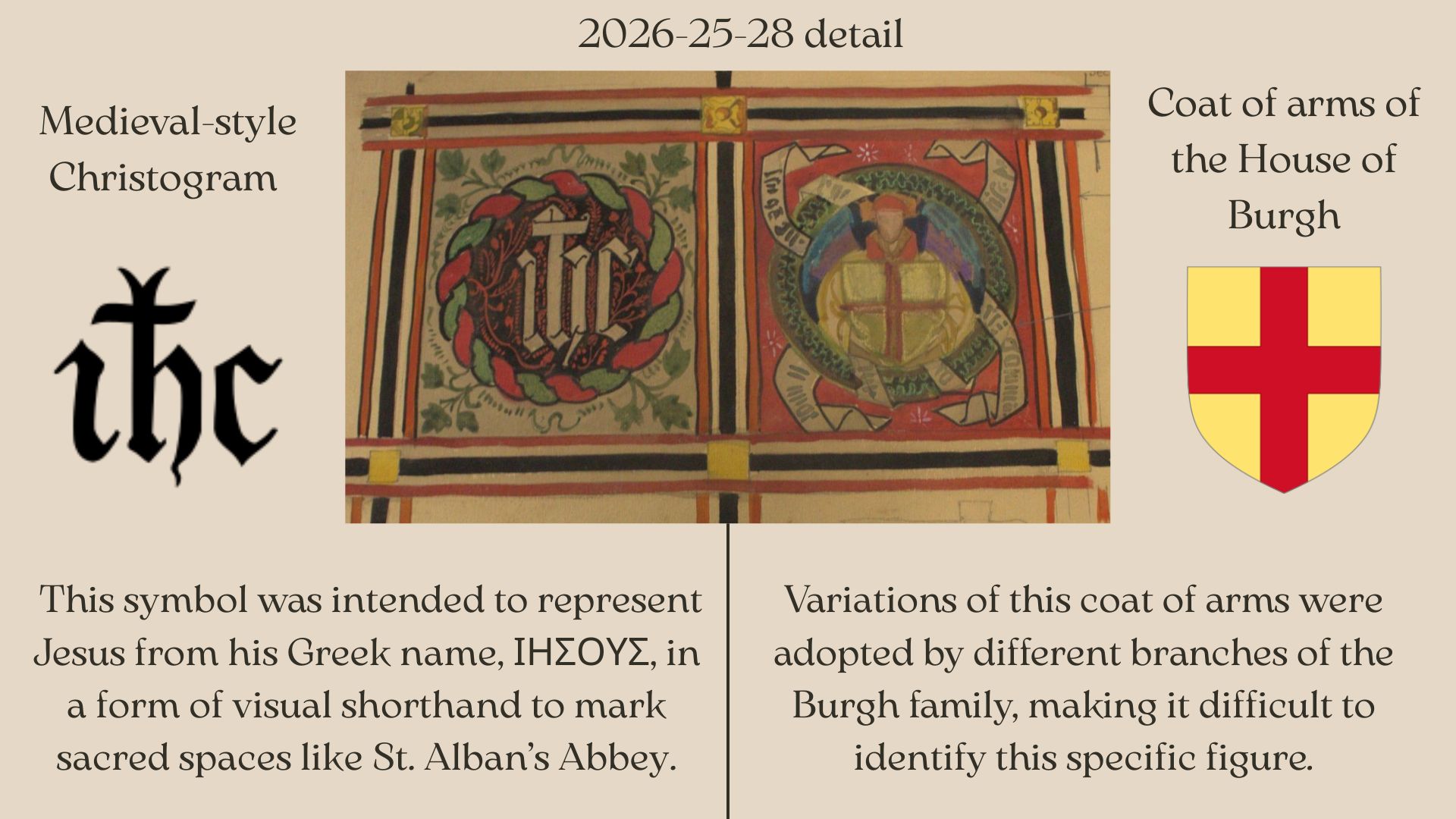
Purves notes on 2026-25-28 that he intended for the backgrounds to be painted “in the manner of English 14th century card manuscripts.” The Christogram (Christ monogram) on the left that reads IHC is a traditional symbol of Jesus, especially in medieval-era Western Europe. The Latin letters I and J were not distinct until the 17th century, making I equivalent to J in Jesus’ name, especially in monograms like IHC. The symbol on the right has a yellow coat of arms with a red cross, which is attributed broadly to the House of Burgh– an Irish family who provided multiple kings of England through a matrilineal line, and are ancestors to the reigning British royal family.
When thinking about symbolism, religious or otherwise, it’s crucial to consider the history and lore behind certain icons or symbols because they shape their meaning deeply. It is clear that Austin Purves engaged with the past in such an intentional way to figure out what history he truly wanted to evoke in his work.
Great Litany Book for St. Paul’s Church
In our archival collection, some of the newest Purves material contained pages for a Litany Book. He wrote and illuminated prayers from the Great Litany in addition to the painted Alms Box for St. Paul’s Church in Philadelphia on May 31, 1923. The style of both of these pages are highly congruent with classical medieval-style illumination work, especially the style of calligraphy.
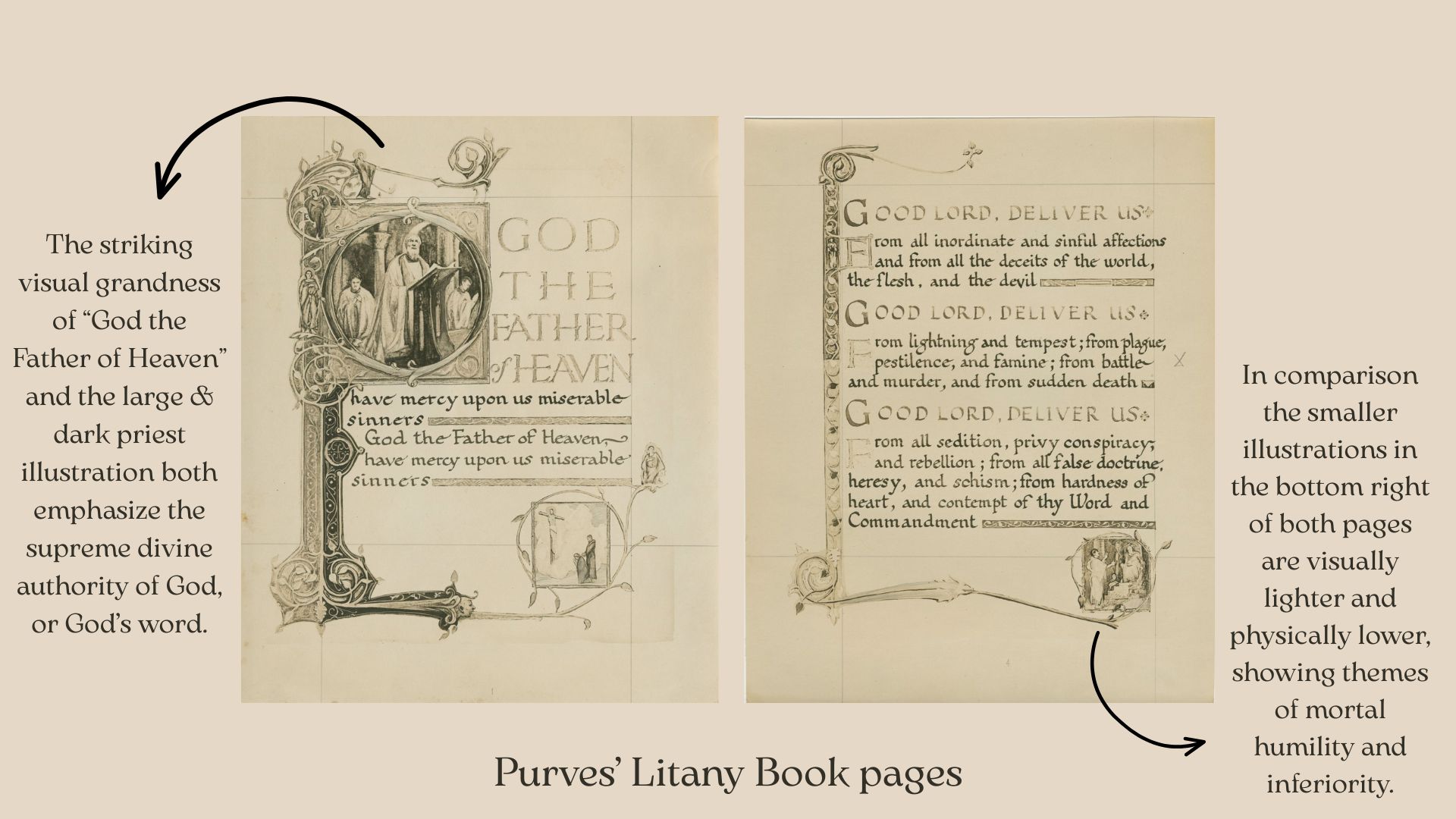
Organic motifs, like the vines and branches seen across both pages, have traditionally been used as symbols for life, the garden of Eden, and growth, contrasting the dark words about death and sin that the vines surround. Perhaps this was intentional, to show that suffering and hope/faith are not mutually exclusive, but fundamentally connected under God? Questions like this will never be able to be fully answered, but asking them regardless and falling into the cycle of seemingly endless contemplation is what creates an active and engaged art viewer.
This collection as a whole demonstrates Austin Purves’ deep curiosity and devotion to religion and art. It can also serve as a reminder for us, the art viewer, to go beyond the surface to consider not just what symbolism may mean now, but what it may have meant before us, and what history is being evoked by its use. To understand art is to understand history, and to understand history is to understand how people experienced it. Throughout history, art has persisted, and now we are able to use it as a way to see how those in the past saw and experienced the world around them.
Author’s Statement
My name is Brooke Vena, and I’m a rising third-year student at Colgate University studying history and museum studies. This summer, as part of my internship at the Litchfield Historical Society, I have had the privilege of processing our newest Austin Purves acquisition. As my final cumulative project for my research over the summer, I’ve chosen to examine Austin Purves’ art to see within it how he experienced both the world around him, his own faith, and how he wanted to capture that– in his local community, in timeless architecture, and in his legacy.